
Two Nigerian Leaders, Two Quotes: Ambition Versus the Price of Power in Politics
Graphic comparing Jonathan’s “no blood for ambition” with Tinubu’s “all is fair in politics” reignites debate on leadership values ahead of 2027.
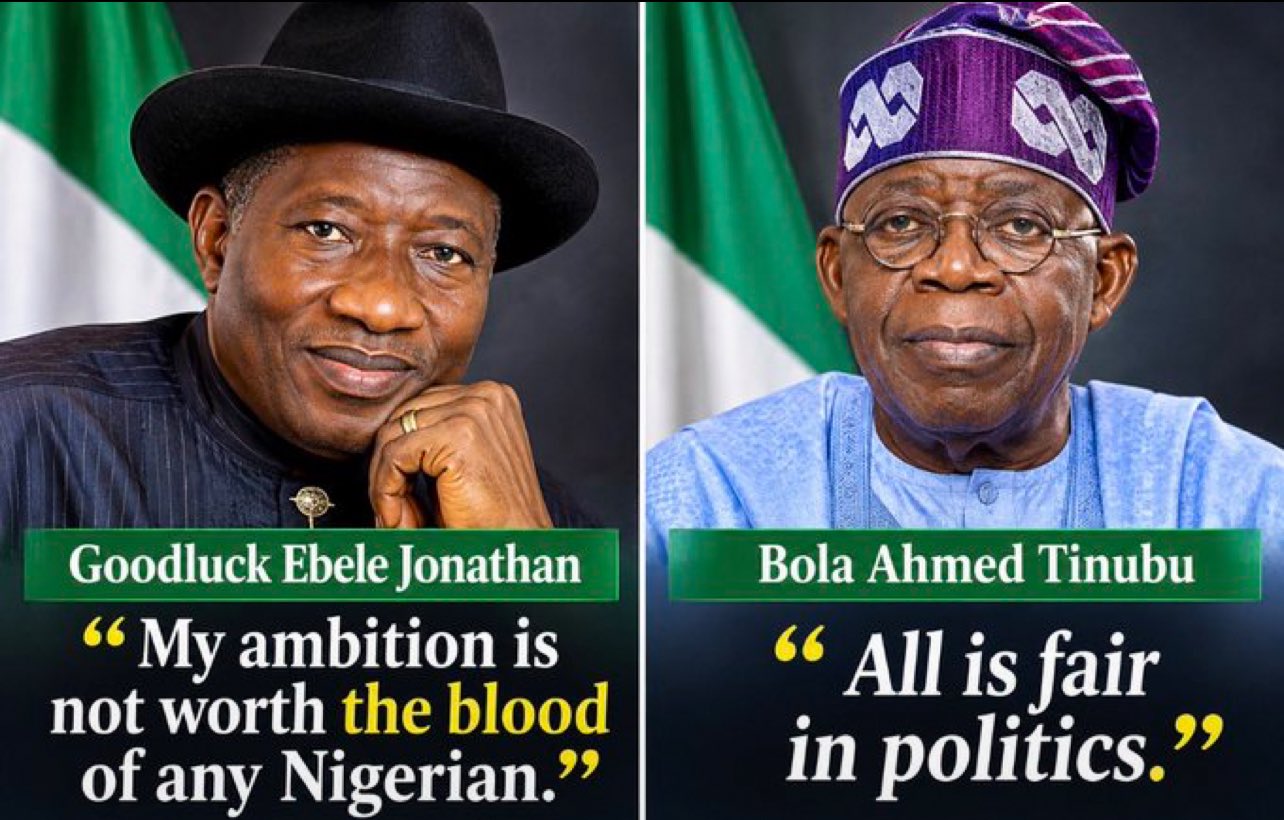
A circulating graphic pairs Goodluck Jonathan’s well-known line—“My ambition is not worth the blood of any Nigerian”—with President Bola Tinubu’s July 2026 remark to Catholic bishops that “all is fair in politics.”
The comparison has fuelled discussion about political norms and security ahead of 2027.
Jonathan’s statement dates to the period around the 2015 election. He publicly stressed that no personal ambition justified violence, and he conceded while results were still being collated. That decision is widely remembered as a moment of restraint.
Tinubu’s comment came during a meeting with Catholic bishops in Abuja. He said political competition involves equal opportunity, that INEC has not intimidated opponents, and that rivals would have to fight for power rather than expect it to be handed over. The phrasing has been interpreted differently by supporters and critics.
Several incidents involving opposition figures have drawn attention in recent weeks.
On 30 October 2026 in Ado-Ekiti, Omoyele Sowore, the African Action Congress presidential candidate, and members of his team were attacked at a restaurant after a radio interview. Sowore reported injuries and said armed men disarmed his security detail.
He and his party described it as an assassination attempt and alleged links to local political actors and security operatives.
Police initially called it an “altercation” with minor injuries; they later arrested 11 suspects and recovered items, including walkie-talkies.
Sowore and supporters have said key alleged organizers remain free and have criticized the pace and scope of the investigation.
On 7 November in Asaba, Delta State, a procession linked to the Nigeria Democratic Congress (NDC) and the Obidient/OK Movement turned violent. Police confirmed one person was killed and five injured. Vehicles were damaged.
Authorities said organizers had been warned against a road procession because of security risks and proceeded anyway. NDC figures, including Senator Ovie Omo-Agege, alleged an attack by thugs linked to the state government. Investigations were announced.
On 5 November in Kebbi, the campaign convoy of former Vice-President Atiku Abubakar (African Democratic Congress) was attacked. Stones were thrown, vehicles damaged, and media equipment smashed. Amnesty International Nigeria issued a strong condemnation after analyzing video footage of the incident.
The organization said the footage showed armed gangs carrying weapons, attacking vehicles in the convoys, striking people with cutlasses, and blocking roads.
One verified recording from Argungu Local Government Area showed opposition members being chased, severely beaten, and their vehicles destroyed.
Amnesty noted that attackers also pelted vehicles with bottles and stones and specifically targeted media crews, destroying cameras and other equipment in what it described as an attempt to prevent documentation of the events.
Amnesty characterized the Kebbi attack as part of a troubling pattern, coming days after similar violence against ADC campaign activities in neighboring Sokoto State.
It described the incidents as a “brutal campaign of repression” that is making it increasingly difficult for opposition parties and their supporters to exercise rights to freedom of association and peaceful assembly.
The group stated that Nigerian authorities have so far failed to ensure accountability for such attacks in several states, including Niger, Kaduna, Edo and Enugu, and that security agencies have failed in their duty to prevent or stop the violence.
Amnesty called for thorough investigations, prosecution of perpetrators and any sponsors, and protection for all political actors regardless of affiliation.
These events have raised questions about the safety of opposition campaigning and the consistency of institutional responses.
Police have made arrests in the Ekiti case and opened probes elsewhere, but opposition parties and rights groups argue the action has often been slow or incomplete and that public confidence in even-handed security is low.
On language, INEC has publicly criticized the “rig and die” slogan used by some opposition figures, including Ovie Omo-Agege, warning that it risks endangering electoral officials, agents, and voters and that disputes should go through lawful channels.
The same commission has been quieter on remarks such as the one by Edo APC chairman Jarret Tenebe, who referred to “AK-47 fire” against anyone standing in the way of delivering a large vote target for Tinubu. That comment drew condemnation from opposition parties, Amnesty International, and rights groups, who called for an investigation.
Political violence is not new in Nigeria, and both ruling and opposition actors have faced accusations over the years.
What stands out in the current cycle is the concentration of high-profile incidents against opposition activities in a short period, combined with uneven official reactions to inflammatory rhetoric and the concerns raised by groups such as Amnesty International about patterns of impunity.
Whether this reflects organised intimidation, local political rivalries, weak enforcement, or a mix of factors remains contested and under investigation in the specific cases.
Jonathan’s emphasis on prioritizing national peace over personal power is still cited as a benchmark. The practical test is whether institutions—police, electoral bodies, and the courts—treat threats and violence the same way regardless of who is targeted or who makes the statements. The coming months will show whether that standard holds.
Community Additions
Have a news tip, correction, or extra context about this story? Post it below. Submissions appear here straight away.