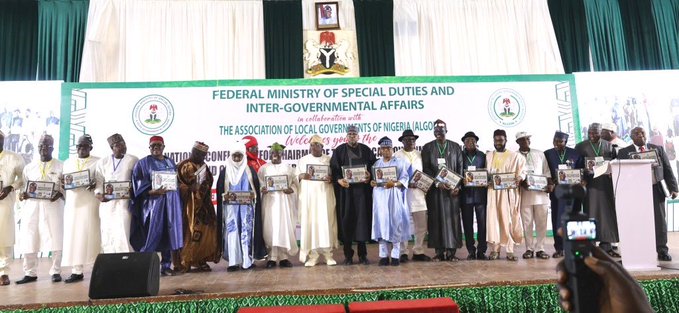
Olukoyede Warns LG Chairmen: Accountability Must Now Reach Nigeria’s Grassroots
Abuja, Nigeria—September 22, 2026—Economic and Financial Crimes Commission (EFCC) Chairman Ola Olukoyede on Tuesday assured local government council chairmen and traditional rulers that the fight against corruption will no longer stop at the federal or state level.
Speaking at the maiden Annual National Conference of Local Government Council Chairmen and Traditional Rulers Councils in Abuja, he declared that accountability must penetrate the grassroots if development is to reach ordinary Nigerians.
Represented by the Director of Public Affairs, Commander Wilson Uwujaren, Olukoyede told the gathering that as more resources flow to the third tier of government, the real test of success will be whether those funds translate into better roads, schools, healthcare, and livelihoods in communities across the country.
“The EFCC is equally committed to transparency and accountability at the sub-national level and would want to see the improved resources flow to the third tier of government translate into improvement in the quality of lives of the grassroots population,” he said.
Recoveries Turned into Public Good
Olukoyede highlighted the Commission’s track record, noting that between October 2023 and the period covered by its recent stewardship account, the EFCC recovered more than ₦1.233 trillion, alongside approximately $684.48 million, £373,905.78 and €9.34 million in foreign currencies.
Roughly two-thirds of the naira recoveries were returned to ministries, departments, agencies, state revenue services, companies, and individuals. Federal and state tax recoveries alone totalled about ₦288.1 billion.
He stressed that recovery only delivers full value when assets are returned to citizens or converted into productive national use.
Approximately ₦661.32 billion and $492.37 million had already been released to beneficiaries.
In a concrete demonstration of this approach, the Federal Government directed ₦50 billion each from recovered funds to the Nigerian Education Loan Fund (NELFUND) and the Nigerian Consumer Credit Corporation (CREDICORP), with further funding later approved.
The former NOK University in Kaduna State, forfeited and transformed into the Federal University of Applied Sciences, Kachia, had enrolled 1,909 students by December 2025.
Linking Corruption to National Security
Olukoyede emphasised that economic crime and security threats can no longer be treated as separate issues. He pointed to the financing of terrorist organizations, illegal mining, cross-border cybercrime and money laundering as serious national security concerns.
The Commission’s specialized enforcement portfolio has recorded 920 cases and 212 convictions in these areas, with investigations and prosecutions continuing.
Almost 60 percent of the EFCC’s processes and operations have been digitalized, supported by continued investment in the Cybercrime Rapid Response Centre and investigative technology aimed at protecting Nigeria’s growing digital economy.
President Tinubu’s Bottom-Up Vision
President Bola Ahmed Tinubu, represented by Secretary to the Government of the Federation George Akume, reinforced the message.
He said his administration’s vision is to shorten the distance between government and the governed, widen access to services, and create more centres of local development.
“Since 2023, [we have] pursued national development with a strengthened belief that Nigeria cannot develop from the centre alone. Development must take root from the bottom up,” the President stated.
He charged the local government chairmen to deliver better primary healthcare, basic education, rural roads, safe water, stronger food systems, and opportunities for women and young people.
Olukoyede also linked Nigeria’s exit from the Financial Action Task Force (FATF) grey list in October 2025 to sustained inter-agency reforms in which the EFCC played a central role.
He described the anti-corruption fight as an instrument for economic growth, national reputation, and investor confidence.
A Call for Living Accountability
The EFCC Chairman urged that accountability become “a living principle rather than a slogan” across all tiers of government.
He noted that the Commission is strengthening its own internal standards, including new arrest and bail guidelines and conflict-of-interest safeguards, so that an institution demanding accountability from others also holds itself to the same standard.
“No title should place anyone outside the reach of the law, but neither should the fight against corruption be separated from due process,” he added.
As local governments receive increased allocations, the conference and Olukoyede’s message signal a renewed focus on ensuring that resources meant for the grassroots actually reach the people they are intended to serve.
 politics
 Speaker Abbas Urges Religious Leaders to Champion Peace Ahead of Nigeria’s 2027 Elections
 politics
 Kwankwaso Vows NDC Will Restore Fuel Subsidy in New Form to End Economic Mess
 news
news Oyo Police Arrest Three Suspects, Recover Stolen Hyundai Sonata from Lagos
 news
news Sowore Accuses Tinubu of Medical Cover-Up as President Extends Europe Stay, Skips UNGA Again
 news
news Supreme Court Affirms Eda Oniyo as Ilejemeje LG Headquarters, Dismisses Iye Appeal
How do you feel about this news?
Community Additions
Have a news tip, correction, or extra context about this story? Post it below instantly. All submissions appear live on this screen immediately.