Dickson: Obi, Kwankwaso Not More Qualified Than Me
In a pointed interview, NDC national leader pushes back against narratives crediting star recruits for the party’s rise, insisting the platform is a gift freely given ahead of 2027
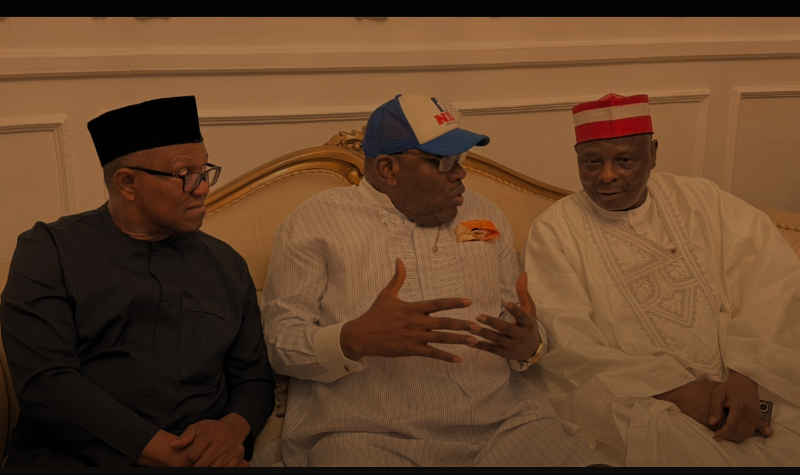
ABUJA, Nigeria— Senator Henry Seriake Dickson, the founder and national leader of the Nigeria Democratic Congress (NDC), has declared that neither Peter Obi nor Rabiu Musa Kwankwaso is more qualified than he is to run for president of Nigeria.
Speaking Wednesday night on Arise Television’s Prime Time programme, the former Bayelsa State governor and current senator for Bayelsa West delivered a firm rebuttal to any suggestion that the NDC’s growing visibility stems primarily from the addition of high-profile figures.
“No one is more qualified than me to run for president, I could have run for president before they (Obi) came. And for some reasons I did not want to,” Dickson said.
“Don’t make it look like anyone is doing NDC a favour. No one is. Rather, the NDC, I and my colleagues, are the ones doing people a favour by granting our platform to them.”
He went further, revealing that neither Obi (the party’s sole presidential candidate) nor Kwankwaso (its vice-presidential candidate) paid a single naira — or “shishi” — for their nominations. The platform, he stressed, was offered freely because the party believed in them.
Dickson’s comments come at a delicate moment for the young NDC.
Just weeks after a special convention where Obi was adopted unopposed as the party’s 2027 flagbearer — with the presidential ticket zoned to the South — the party issued a strongly worded statement against personality-driven politics.
It warned that the Obidient and Kwankwasiya movements would not be allowed to operate as parallel structures that overshadow party supremacy, internal discipline, and institutional building.
Some supporters of the popular duo have reportedly pushed back, accusing the leadership of ingratitude or even plotting to sideline Obi.
Dickson dismissed such talk as “nonsense,” insisting there is “no crisis” and that Obi remains “a cherished member” with whom the party is “working well together.”
Any friction, he said, comes from a small number of supporters who disparage the platform while claiming loyalty to its candidates.
The NDC itself is the product of Dickson’s deliberate break from the Peoples Democratic Party (PDP) after years in opposition.
Since 2015, when the PDP lost federal power, he has positioned himself as one of the few opposition governors willing to “bear the brunt” without seeking accommodation with the ruling party.
He has repeatedly framed the NDC not as a quick vehicle for any individual’s ambition, but as a long-term institutional projects.
A veteran of Nigerian politics, Dickson served as Governor of Bayelsa State from 2012 to 2020.
He later won election to the Senate, representing Bayelsa West. Known for a measured, sometimes understated style, he has long cultivated an image as a serious, institution-minded politician rather than a crowd-pulling populist.
In early 2026 he launched the NDC, initially dismissed by many as yet another fringe platform. Within months, however, it attracted Obi (fresh from his strong 2023 showing) and Kwankwaso, creating what supporters called the “OK movement.”
Observers noted the unusual convergence: two of Nigeria’s most recognisable opposition figures joining a party founded and led by a lesser-known (nationally) former governor from the South-South.
Dickson has consistently downplayed personal presidential ambitions in recent months, telling interviewers he was focused on “building the platform” and was “not declaring for president yet.” Wednesday’s interview marked his most direct assertion of personal standing to date.
Nigeria’s opposition landscape ahead of the 2027 election remains fragmented and personality-heavy.
The ruling All Progressives Congress (APC) under President Bola Tinubu faces widespread economic discontent, yet no single opposition figure or party has consolidated a clear winning coalition.
The NDC’s bet has been to combine Obi’s massive grassroots appeal (especially among youths and in the Southeast) and Kwankwaso’s northern base with structured party machinery.
Dickson’s intervention highlights the inherent tension in that project: popular movements bring votes and visibility, but they can also import expectations of deference to “the man” rather than the institution.
By reminding everyone that the NDC existed and was already receiving other politicians (including Binani of Adamawa) before Obi joined, Dickson is reasserting founder’s authority and the principle that no individual is bigger than the platform.
At the same time, his claim of superior qualification invites scrutiny. Obi built one of the most formidable volunteer-driven campaigns in recent Nigerian history and remains a darling of urban, educated, and youth voters.
Kwankwaso commands deep loyalty in Kano and parts of the North. Dickson’s strengths lie in governance experience, legislative work, and the painstaking work of party-building from scratch.
One reading is defensive: Dickson is protecting the party’s brand and his own legacy against supporters who treat the NDC as merely “Obi’s new party.”
Another is strategic positioning — a subtle reminder that the ticket, while zoned South and currently occupied by Obi, is not automatically permanent, and that the founder retains significant influence.
A third, more generous reading is philosophical: Dickson is articulating a vision of politics in which experience, sacrifice in opposition, and institutional commitment should count as much as popularity or social media traction.
Whether Nigerian voters in 2027 will reward that philosophy remains an open question.
For now, the comments have injected fresh energy — and fresh questions — into the NDC’s internal dynamics. Supporters of Obi and Kwankwaso will likely demand reassurance that their candidates are respected.
Party loyalists will hail Dickson’s candour as necessary discipline. Neutral observers will watch closely to see whether the “OK” experiment can survive the classic Nigerian tension between movement energy and party structure.
What is clear is that Seriake Dickson is no longer content to let others define the narrative of the party he built.
In a political culture where many leaders prefer coded language, his directness on national television was striking — and, depending on one’s perspective, either refreshing or destabilising.
The 2027 race is still months away. But the battle for the soul of Nigeria’s newest major opposition platform has already begun.
 politics
 Adebayo Challenges Tinubu: Where Is Subsidy Money? Come Out and Account for It
 politics
 NDC Wins Logo Battle as Abuja Court Orders INEC to Use Modified Design
 news
news Atiku Exposes Tinubu’s FAAC Scam: Bigger Naira, Poorer Nigerians
 news
news Police Arrest Hafsat Abubakar Over Fake Fintech Shutdown Document Circulated Online
 politics
 Sowore Declares Peter Obi Yelwata Blockade Government-Sponsored Political Attack
How do you feel about this news?
Community Additions
Have a news tip, correction, or extra context about this story? Post it below instantly. All submissions appear live on this screen immediately.