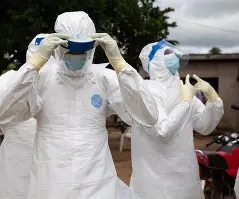
Deadly Ebola Surge Exposes Fragile Global Health Defenses
A rapidly spreading Ebola outbreak in Central Africa is raising alarm among global health experts, exposing deep cracks in the international systems designed to detect, contain, and defeat deadly infectious diseases.
At the center of the crisis is the Bundibugyo strain of Ebola, a rare and particularly challenging variant for which there is currently no approved vaccine or specific treatment.
The outbreak, which began in the eastern Democratic Republic of Congo (DRC), has now crossed into neighboring Uganda, prompting the World Health Organization (WHO) to declare a Public Health Emergency of International Concern (PHEIC), one of the highest levels of global health alerts.
Health authorities warn that the outbreak is unfolding under extraordinarily difficult conditions.
The affected regions are grappling with armed conflict, population displacement, humanitarian emergencies, and weak healthcare infrastructure—all factors that make disease surveillance and containment significantly harder.
According to WHO, the outbreak is occurring in densely populated areas with extensive cross-border movement, increasing the risk of further regional spread.
“The Bundibugyo species of Ebola involved is one for which there is no vaccine or specific treatment,” WHO noted, while emphasizing that emergency efforts are focused on surveillance, contact tracing, clinical care, and community engagement.
Recent reports indicate that confirmed and suspected cases have continued to rise in both the DRC and Uganda.
In Uganda, health authorities recently confirmed six additional Ebola infections, bringing the country’s total number of cases higher as officials intensify monitoring efforts along border communities.
The situation has become even more complicated due to insecurity in outbreak zones. In eastern Congo, attacks on health workers and Ebola response teams have disrupted containment operations.
One burial team was reportedly attacked while carrying out a safe burial, forcing workers to abandon their mission and heightening fears of further transmission.
Similar incidents have injured frontline responders and fueled public mistrust of health authorities.
Despite the grim outlook, there are signs of hope. WHO Director-General Tedros Adhanom Ghebreyesus recently reported that several patients infected with the Bundibugyo strain have recovered, demonstrating that early diagnosis and supportive medical care can improve survival rates even in the absence of approved therapies.
Meanwhile, an international race is underway to develop effective vaccines and treatments.
The Coalition for Epidemic Preparedness Innovations (CEPI) has committed tens of millions of dollars to support vaccine development efforts by researchers, including teams from Moderna, Oxford University, and the International AIDS Vaccine Initiative (IAVI).
Scientists hope clinical trials can begin within months if security and logistics permit.
Public health experts argue that the outbreak is not only a test of medical science but also a test of global preparedness.
The success or failure of containment efforts may depend less on laboratories and more on whether governments, international agencies, and local communities can work together quickly enough to stop transmission chains before they expand further.
For now, the warning from health authorities is unmistakable: Ebola remains one of the world’s deadliest diseases, and the battle against a strain with no approved cure has become a race against time.
 politics
 Adebayo Challenges Tinubu: Where Is Subsidy Money? Come Out and Account for It
 politics
 NDC Wins Logo Battle as Abuja Court Orders INEC to Use Modified Design
 news
news Atiku Exposes Tinubu’s FAAC Scam: Bigger Naira, Poorer Nigerians
 news
news Police Arrest Hafsat Abubakar Over Fake Fintech Shutdown Document Circulated Online
 politics
 Sowore Declares Peter Obi Yelwata Blockade Government-Sponsored Political Attack
How do you feel about this news?
Community Additions
Have a news tip, correction, or extra context about this story? Post it below instantly. All submissions appear live on this screen immediately.