
Trump Elevates Stephen Miller to White House Chief of Staff Role
Longtime immigration hawk and trusted adviser replaces Susie Wiles after GOP midterm setbacks, effective Monday.
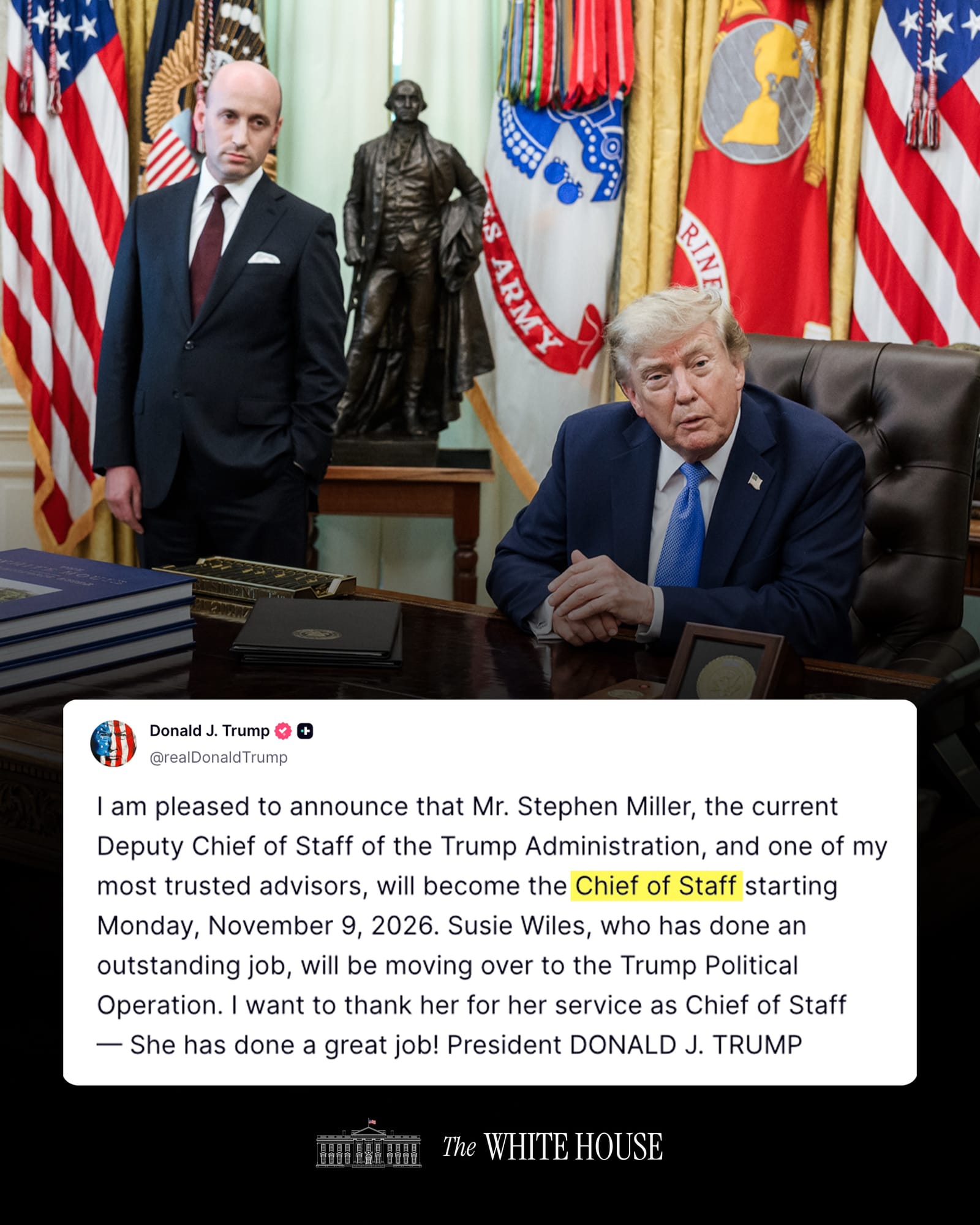
WASHINGTON — President Donald Trump announced Friday that Stephen Miller, his longtime adviser and current White House deputy chief of staff, will take over as chief of staff starting Monday, November 9, 2026.
The move replaces Susie Wiles, who Trump praised for an “outstanding job” and said will shift to the Trump Political Operation.
In a post shared via the official White House account and originally issued on Truth Social, Trump wrote: “I am pleased to announce that Mr. Stephen Miller, the current Deputy Chief of Staff of the Trump Administration and one of my most trusted advisors, will become the Chief of Staff starting Monday, November 9, 2026.
Susie Wiles, who has done an outstanding job, will be moving over to the Trump Political Operation. I want to thank her for her service as Chief of Staff — She has done a great job!”
The announcement, accompanied by a formal Oval Office photo of the two men, marks the first major personnel shake-up of Trump’s second term following this week’s midterm elections.
The timing is striking. Republicans suffered significant losses on Tuesday, losing majorities in both the House and Senate amid voter frustration over the economy and other issues.
Multiple reports indicate Trump grew increasingly angry in the days after the results, directing some of that frustration at campaign and White House strategy. Wiles submitted her resignation Thursday evening, according to sources familiar with the matter.
She had been the first woman to serve as White House chief of staff and Trump’s longest-serving in the role across his two administrations.
In her own statement, Wiles struck a graceful note. “Today is my last day as White House Chief of Staff,” she posted. “Serving President Trump in the White House has been the honor of a lifetime. I’m so proud to have been a part of what we’ve accomplished together, from securing our border and cutting taxes to strengthening our economy and putting America First.
While my role may be changing, my commitment to the President and the mission never will.”
Wiles, who publicly disclosed a breast cancer diagnosis earlier this year and later announced she was in remission, had been a steady, behind-the-scenes operator who managed Trump’s successful 2024 campaign return.
Miller, 41, brings a very different profile. Born in Santa Monica, California, to a liberal Jewish family, he gravitated toward conservative politics early, writing pointed columns at Duke University and later working as a congressional staffer for Representatives Michele Bachmann and John Shadegg before becoming communications director for Senator Jeff Sessions.
He joined Trump’s 2016 campaign as a senior policy adviser and speechwriter, helping craft the “American carnage” inaugural address and remaining one of the few original aides to serve through both terms.
In the second Trump administration, Miller has served as deputy chief of staff for policy and homeland security adviser, expanding his influence across domestic policy while remaining the principal architect of the president’s hardline immigration agenda—including mass deportation efforts, border enforcement, and earlier policies such as the travel restrictions from certain Muslim-majority countries and family separations at the southern border.
Supporters view him as a disciplined ideologue who delivers results; critics call him polarizing and extreme.
Either way, elevating him to the top staff job signals a sharper, more confrontational approach as the administration faces a Democratic-controlled Congress.
Miller will be among the youngest chiefs of staff in modern history. His promotion consolidates power around a figure who has long operated as one of Trump’s most loyal and ideologically aligned advisers.
With divided government now a reality, the White House under Miller is expected to lean heavily on executive authority, particularly on immigration and border security—issues that remain central to Trump’s political brand.
The change takes effect Monday. Wiles moves into the political operation, keeping her in the broader Trump orbit. For Miller, the new title formalizes the considerable influence he has already wielded.
In a capital still absorbing the midterm results, the message from the Oval Office is clear: the president is doubling down on the advisers who have defined his agenda from the start.
Community Additions
Have a news tip, correction, or extra context about this story? Post it below. Submissions appear here straight away.