National Policing Bill 90% Ready — Hits NASS in Two Weeks
Abuja, Nigeria – 15 October 2026 – The Federal Government is on the verge of transmitting a landmark National Policing Bill to the National Assembly, with the Presidential Working Group declaring the draft 90 per cent complete and ready for legislative action within two weeks.
Chief of Staff to the President and Chairman of the Working Group, Rt. Hon. Femi Gbajabiamila, made the announcement on Thursday after a steering committee meeting held at the State House in Abuja.
He told journalists that only one more meeting was needed to finalize outstanding details before the bill is formally forwarded to lawmakers.
“The National Policing Bill is more or less ready for transmission to the National Assembly. We will probably have one more meeting after this to cross the t’s and dot the i’s and make sure every area is covered. So, we are 90% ready,” Gbajabiamila said.
“The governors have one or two observations, and we should be ready in about a week or so.”
He described the proposed legislation as “the most consequential Bill of the administration so far.” According to him, the draft has undergone rigorous and intensive deliberations since the steering committee of the Presidential Working Group began its work on 3 August 2026.
The bill is expected to provide the operational and legal framework for a reformed policing architecture in Nigeria, complementing ongoing efforts to amend the Constitution to allow for the establishment of state police. While the constitutional amendment process (the Sixth Constitution Alteration Bill) requires the concurrence of state Houses of Assembly, the National Policing Bill is designed to spell out the practical mechanisms for funding, recruitment, training, command structure, and coordination between federal and state police forces once the constitutional foundation is in place.
On the slow pace of state-level action on the constitutional amendment, Gbajabiamila expressed confidence that the process would not stall.
Reports indicate that only about six states have so far passed the Sixth Constitution Alteration Bill out of the 36 states and the Federal Capital Territory.
Despite this, the Chief of Staff insisted there was a clear national consensus on the need for the reforms.
“I see no reason why anyone will want to have a rethink on it,” he stated.
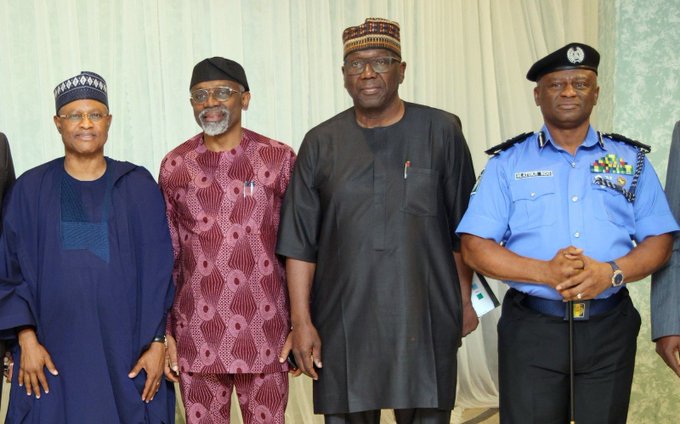
Thursday’s meeting brought together key stakeholders in the reform process. Participants included the Chairman of the Nigeria Governors’ Forum and Governor of Kwara State, AbdulRahman AbdulRazaq; Governor Dapo Abiodun of Ogun State; Governor Uba Sani of Kaduna State; Inspector-General of Police, Tunji Disu; and the Attorney-General of the Federation and Minister of Justice, represented by the Solicitor-General and Permanent Secretary of the Federal Ministry of Justice, Mrs Beatrice Jedy-Agba.
Also present were Justice Abdullahi Liman (rtd), Chairman of the Policy Advisory Committee; Professor Olu Ogunsakin, Head of the Nigeria Police Reform Secretariat; Dr Lanre Smart, Special Adviser to the President on National Assembly Matters (House of Representatives); Nnadubem Moghalu, Senior Special Assistant to the President on Planning and Research and Secretary of the Committee; a representative of the President of the Nigerian Bar Association; and AIG Abraham Nabhon Thomas, representing the National Security Adviser.
The push for a new national policing framework comes against the backdrop of persistent security challenges across the country and long-standing public demand for a more decentralized and responsive police system.
Successive administrations have grappled with the idea of state police, but the Tinubu government has made the dual reforms—constitutional amendment and a comprehensive policing bill—a major policy priority.
Officials have previously indicated that once the bill is transmitted to the National Assembly, it will also be made available for public scrutiny to allow broader input before final passage.
With the Working Group signalling that the draft is nearly complete, attention will now shift to the National Assembly, where the bill is expected to undergo thorough legislative scrutiny.
At the same time, pressure continues to mount on the remaining state Houses of Assembly to accelerate action on the constitutional amendment that would legally enable state police structures.
If the timelines hold, the National Policing Bill could soon become one of the defining legislative milestones of the current administration — a practical step towards reshaping how Nigeria polices itself in the years ahead.
 news
Court Jails Former Banker 39 Years Over N2.7bn Fraud Case
 news
Sowore Accuses ARISE TV of False Report on Court Hearing with DSS
 news
Sowore Accuses ARISE TV of False Report on Court Hearing with DSS
 sport
Manchester United Back Carrick with More Time Despite Mounting Pressure, Poor Form
 technology
MTN Insists “We’re Not Stealing Your Data” as Furious Customers Cry Foul Over Sudden Vanish
How do you feel about this news?
Community Additions
Have a news tip, correction, or extra context about this story? Post it below instantly. All submissions appear live on this screen immediately.