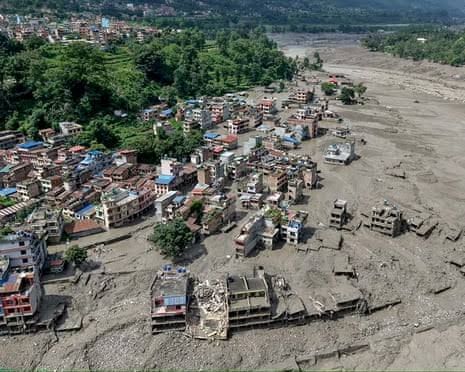
Deadly Flash Floods Devastate Nepal-Tibet Border, Killing Nearly 100
Kathmandu / Border Region – August 26, 2026 — A sudden and catastrophic flash flood tore through communities along the Nepal-Tibet border on Wednesday morning, leaving at least 95 people dead in Nepal and hundreds more missing, including large numbers of foreign tourists.
The disaster, which sent walls of water, mud, and debris racing through river valleys, has devastated villages, washed away bridges and roads, and disrupted hydropower infrastructure in one of the most scenic yet vulnerable stretches of the Himalayas.
The floods struck early Wednesday in Nepal’s Rasuwa district, just north of Kathmandu, with the Bhote Koshi (also referred to as Bhotekoshi) and Trishuli river systems bearing the brunt.
Preliminary assessments point to a massive avalanche of ice and rock—possibly triggered by a seismic event or glacial instability—that poured meltwater and debris into the rivers, creating a cascading flood that swept downstream into neighboring districts including Nuwakot.
A Cross-Border Tragedy Unfolds
Chinese authorities reported at least three deaths and around 265 people missing on their side of the border in Gyirong County, Tibet, where a mudslide struck a key land crossing, cutting roads, power, and communications.
Combined figures from both sides have pushed the overall death toll higher in some updates, with rescue operations continuing under difficult conditions.
Hundreds of travelers remain unaccounted for. Nepal’s tourism authorities have reported figures ranging from roughly 384 to over 400 missing people in the affected areas, the majority foreign nationals.
Among them are large groups of Indian pilgrims heading toward Mount Kailash in Tibet, a sacred site for Hindus, as well as citizens from the United States, United Kingdom, Australia, Canada, Malaysia, South Korea, and other countries.
Local Nepalis, including trekkers near Gosaikunda Lake and security personnel whose barracks were swept away, are also among the missing.
Videos circulating online captured the terrifying moment torrents of water and debris engulfed buildings and vehicles near the border, with people fleeing in panic.
Aerial footage later revealed the scale of destruction: homes half-submerged in sludge, collapsed bridges, and scarred riverbanks.
Rescue Efforts Underway Amid Challenging Terrain
Nepali security forces, led by the army, have mobilized helicopters and ground teams. Dozens of people have been rescued so far, with some of the more seriously injured airlifted to Kathmandu.
High water levels initially prevented helicopter landings in the hardest-hit zones of Syapru Besi and Timure.
Authorities have urged residents downstream to stay clear of riverbanks and issued flood alerts for areas further south, including parts of India where rivers feed into the plains.
Nepal’s Foreign Minister briefed parliament that an earthquake-like tremor around 8:37 a.m. local time may have triggered the avalanche that led to the glacial lake or ice collapse minutes later.
Experts monitoring the region have pointed to the increasing risks of glacial and rock-ice avalanches in a warming Himalaya.
Prime Minister Balendra Shah convened an emergency cabinet meeting to coordinate rescue and relief.
The government has appealed for assistance from India and China while assessing damage to at least 19 bridges, roughly 40 kilometers of roads, and multiple hydropower projects that supply a significant share of the country’s electricity.
Human Cost and Ongoing Uncertainty
Behind the numbers lie families waiting for news of loved ones—pilgrims on spiritual journeys, adventure travelers, local residents, and workers at remote project sites.
South Korean officials confirmed several of their nationals working on a hydropower plant were among those unaccounted for, while British and American tour groups have reported missing members.
As search teams comb the mud and debris under difficult weather and terrain conditions, the full human and economic toll continues to emerge.
This disaster ranks among the most severe natural events to hit Nepal since the devastating 2015 earthquake, underscoring the growing vulnerability of high-altitude communities to sudden geological and climate-related hazards.
Authorities on both sides of the border continue intensive search-and-rescue operations. Updates on the missing and confirmed casualties are expected as recovery efforts progress through the night and into the coming days.
 politics
 Adebayo Challenges Tinubu: Where Is Subsidy Money? Come Out and Account for It
 politics
 NDC Wins Logo Battle as Abuja Court Orders INEC to Use Modified Design
 news
news Atiku Exposes Tinubu’s FAAC Scam: Bigger Naira, Poorer Nigerians
 news
news Police Arrest Hafsat Abubakar Over Fake Fintech Shutdown Document Circulated Online
 politics
 Sowore Declares Peter Obi Yelwata Blockade Government-Sponsored Political Attack
How do you feel about this news?
Community Additions
Have a news tip, correction, or extra context about this story? Post it below instantly. All submissions appear live on this screen immediately.