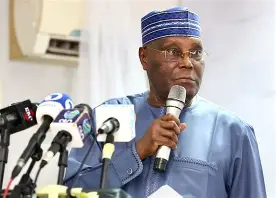
Economist Backs Atiku’s Call to Rethink Fuel Subsidy Amid Rising Hardship
Lagos, August 23, 2026—Consulting economist and business sustainability expert Dr. Marcel Okeke has explained that the removal of fuel subsidy under President Bola Tinubu came with significant trade-offs, which helps explain why former Vice President Atiku Abubakar is now calling for its reconsideration.
Speaking on ARISE News’ This Day Live, Okeke noted that while economic reforms often involve difficult choices, the growing hardship faced by ordinary Nigerians makes Atiku’s position understandable.
“In economics, we talk about trade-offs. When you consider the cost of subsidy removal and the growing hardship faced by Nigerians, you can understand why Atiku would consider bringing it back,” he said.
Okeke acknowledged that the World Bank has described the reforms as stabilizing the economy.
However, he stressed that millions of Nigerians continue to struggle with no clear end in sight to the pressures on household incomes, transportation costs and the broader cost of living.
Atiku’s Targeted Subsidy Proposal
Atiku, the African Democratic Congress (ADC) presidential candidate for 2027, has argued that the removal of petrol subsidy in May 2023 has not delivered the expected benefits to citizens.
He has proposed a redesigned, production-based support mechanism rather than a return to the old open-ended import subsidy regime.
Under his plan, preferential crude allocation would go to qualifying Nigerian refineries, with the subsidy tied to verified domestic production.
The arrangement would include a fixed annual spending ceiling, independent audits, and measures to prevent diversion, with the goal of eventually building a refining industry strong enough to operate without ongoing support.
Atiku has repeatedly asked where the savings from subsidy removal have gone, citing large energy-security expenses and under-recoveries recorded in NNPC Limited’s audited accounts even after the policy change.
He maintains that Nigerians were promised the reforms would free resources for healthcare, education, security and infrastructure.
Government Pushback
The Presidency has strongly rejected Atiku’s position, describing it as a political U-turn and an opportunistic recantation of his earlier support for subsidy removal during the 2023 campaign.
Officials argue that restoring any form of subsidy would reverse hard-won fiscal gains that have improved allocations to states and local governments and reduced opportunities for the corruption and round-tripping that characterized the previous system.
Special Adviser to the President on Media and Public Communications, Sunday Dare, accused Atiku of playing politics with the economy and said the former vice president’s reversal exposed a willingness to prioritise short-term political gain over national economic stability.
The Wider Debate
The exchange has sharpened the economic fault lines ahead of the 2027 elections. Supporters of the current reforms point to increased Federation Account allocations and the need to end an unsustainable regime.
Critics, including Atiku and some independent analysts, insist that the human cost remains too high and that targeted, transparent support for domestic refining could ease the burden without recreating past abuses.
Okeke’s comments on ARISE News add a measured economic perspective to a debate that is increasingly dominating political discourse.
For many Nigerians still grappling with elevated fuel prices and the ripple effects on food and transport costs, the question remains whether the trade-offs of subsidy removal have been worth the pain—and whether a different approach is now required.
 politics
 Adebayo Challenges Tinubu: Where Is Subsidy Money? Come Out and Account for It
 politics
 NDC Wins Logo Battle as Abuja Court Orders INEC to Use Modified Design
news Atiku Exposes Tinubu’s FAAC Scam: Bigger Naira, Poorer Nigerians
 news
news Police Arrest Hafsat Abubakar Over Fake Fintech Shutdown Document Circulated Online
 politics
 Sowore Declares Peter Obi Yelwata Blockade Government-Sponsored Political Attack
How do you feel about this news?
Community Additions
Have a news tip, correction, or extra context about this story? Post it below instantly. All submissions appear live on this screen immediately.