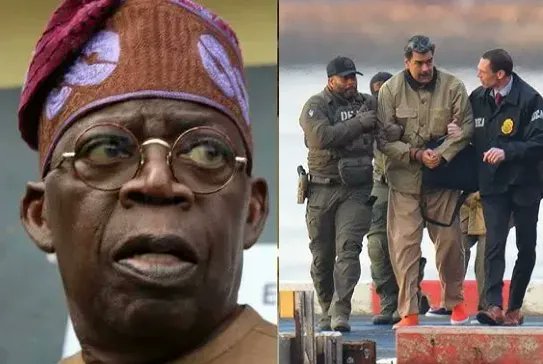
Tinubu Worse Than Maduro — American Fires Explosive Call for US Military Action in Nigeria
In a sharply worded statement that has ignited fierce debate across Nigerian social media and diaspora circles, retired American mental health counselor Jeffrey Guterman has accused President Bola Ahmed Tinubu of surpassing Venezuelan leader Nicolás Maduro in harm inflicted on his nation.
Guterman, a vocal critic of Tinubu since the 2023 election, urged the United States to deploy troops to Nigeria and arrest the president, framing it as a necessary response to longstanding narcotics-related allegations and the country’s deepening economic crisis.
The remarks, shared widely on platforms like X by news aggregator Parallel Facts, reference historical U.S. Department of Justice documents from a 1993 civil forfeiture case involving approximately $460,000 in funds linked to Tinubu.
Those proceedings, which ended in a settlement without criminal conviction, have long been a flashpoint in Nigerian politics. Tinubu has consistently denied any involvement in wrongdoing.
Guterman drew direct parallels between Nigeria under Tinubu and Venezuela under Maduro, citing hyperinflation, poverty, emigration, and governance failures.
“Tinubu has done worse than Venezuela’s Maduro,” he asserted, calling for decisive U.S. intervention.
His comments come amid renewed scrutiny of Tinubu’s past, including ongoing Freedom of Information Act (FOIA) litigation in U.S. courts seeking fuller disclosure of FBI and DEA files related to 1980s-1990s investigations into a Chicago-area heroin trafficking ring.
Nigeria has indeed faced severe economic headwinds since Tinubu assumed office in May 2023. The removal of fuel subsidies, naira flotation, and global factors has fueled inflation, currency volatility, and hardship for millions.
Critics point to insecurity, youth unemployment, and emigration (“Japa”) as symptoms of broader systemic strain.
Supporters, however, highlight reforms aimed at long-term stabilization, infrastructure projects, and efforts to diversify the economy beyond oil.
Guterman, who has previously filed FOIA requests for Tinubu-related FBI files and engaged in public debates, is no stranger to controversy.
His latest intervention taps into polarized sentiments, particularly among opposition voices and diaspora communities frustrated with governance.
The core of the narcotics claims stems from a 1990s U.S. investigation. Court documents from the era alleged that funds in accounts controlled by Tinubu were potentially linked to heroin proceeds involving associates like Abiodun Agbele and Mueez Akande.
A civil forfeiture action resulted in the $460,000 settlement. No criminal charges were filed against Tinubu, and he has maintained the matter was resolved decades ago without admission of guilt.
Recent developments include U.S. court orders compelling greater disclosure from the FBI and DEA, as well as lobbying efforts by figures linked to opposition leader Atiku Abubakar submitting records to the Trump administration and Congress.
These actions keep the issue alive in public discourse, even as Tinubu’s administration focuses on domestic policy.
Analysts caution against direct equivalence with Maduro’s Venezuela, which endured catastrophic hyperinflation, institutional collapse, and mass exodus.
Nigeria’s challenges, while acute, occur in a different context of democratic institutions, regional influence, and ongoing reforms. Comparisons often serve rhetorical purposes in heated political debates.
Guterman’s call for U.S. troops has drawn mixed responses—strong support from some anti-Tinubu voices online, dismissal by others as inflammatory or unrealistic, and concern from moderates about escalating foreign intervention rhetoric. Nigerian officials and ruling APC supporters have historically rejected such allegations as politically motivated smears.
The episode underscores deeper tensions: questions of leadership legitimacy, economic pain felt by ordinary citizens, and the enduring shadow of past controversies in Nigerian politics.
As the country navigates reforms and prepares for future elections, such statements fuel division at a time when unity and pragmatic solutions are arguably most needed.
Whether Guterman’s provocative intervention prompts any official U.S. response remains to be seen. For now, it serves as a stark reminder of the passions and fractures defining Nigeria’s contemporary political landscape.
 news
news Tinubu Set to Crush Obi, Atiku in 2027 Poll
 news
news Israel Urges Nigerian Doctors for Capacity Training Abroad
 news
news Kano Woman Stabs Boyfriend, Severs Manhood Completely
 world
world Trump Hails Court Win Over New York Times Lawsuit
 news
news Minister Hails NTA’s World-Class Studio in Tinubu Media Push
How do you feel about this news?
Community Additions
Have a news tip, correction, or extra context about this story? Post it below instantly. All submissions appear live on this screen immediately.