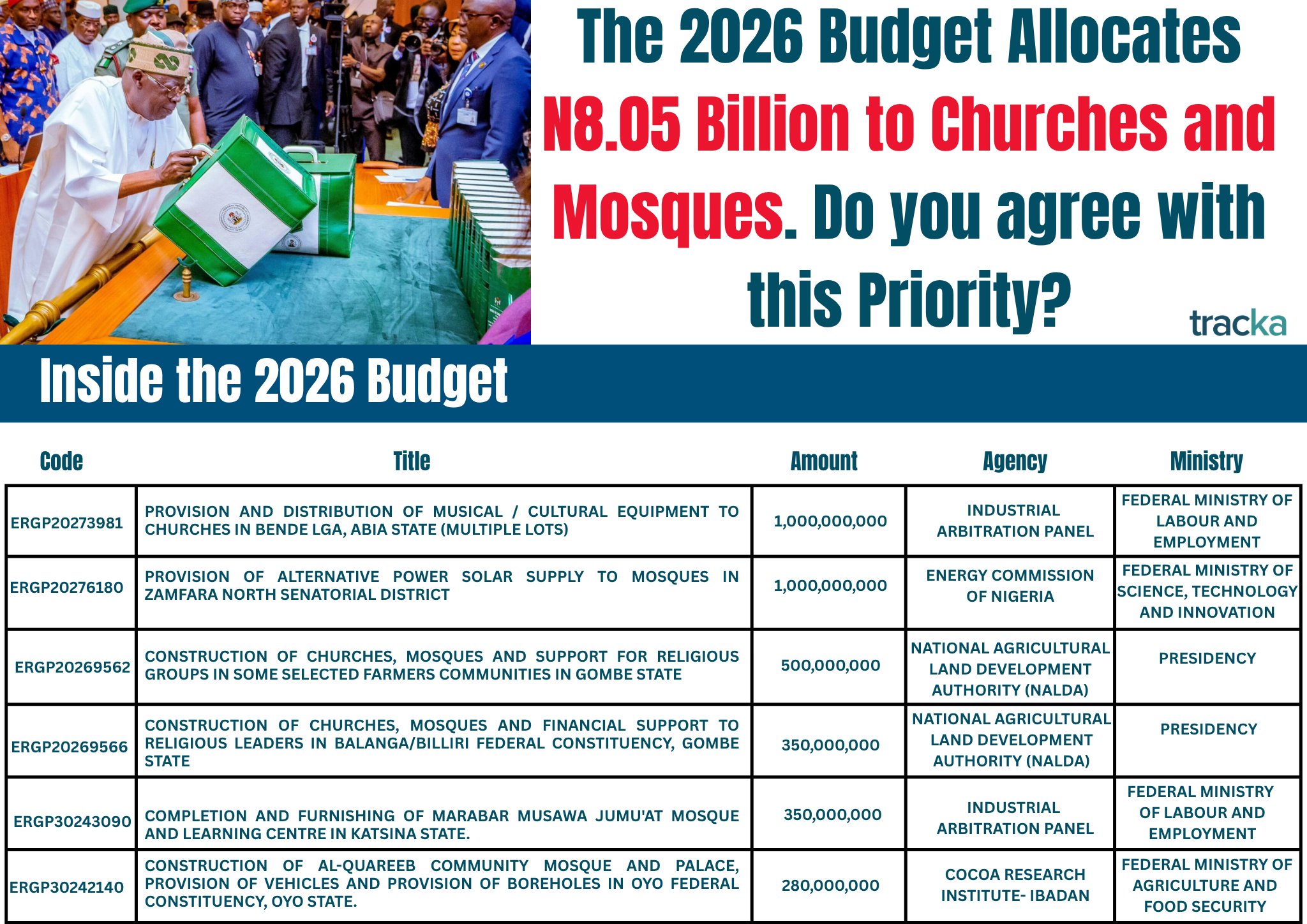
National Debate as ₦8.05 Billion Faith-Based Projects Raise Questions Over Nigeria's Budget Priorities
As Nigeria battles deepening economic hardship, mounting public debt, overstretched healthcare facilities, failing schools, and deteriorating infrastructure, a fresh revelation from civic accountability organisation Tracka has reignited a national conversation over how public funds are being allocated—and whether government spending truly reflects the country’s most urgent needs.
At the centre of the debate is the disclosure that the 2026 Federal Government Budget earmarks ₦8.05 billion for the construction, renovation, and support of churches and mosques, despite the budget operating with a ₦31.45 trillion fiscal deficit, representing approximately 46 percent of the total budget size.
The figures, published by Tracka, a citizen-led accountability platform under the BudgIT Foundation, have generated widespread reactions from Nigerians, policy analysts, civil society groups, and public finance experts who argue that the revelation raises fundamental questions about fiscal discipline, governance priorities, and accountability.
Breaking Down the Allocation
According to Tracka’s budget analysis, the allocation comprises:
- ₦1.91 billion for the construction and renovation of seven churches.
- ₦6.14 billion for 52 mosque-related projects, including new mosque construction, rehabilitation works, solar power installations, Islamic learning centres, and other faith-based infrastructure.
The projects are spread across multiple Ministries, Departments, and Agencies (MDAs), including the Presidency, the Federal Ministry of Agriculture and Food Security, and several other government institutions.
Some observers have questioned why agencies whose statutory mandates are unrelated to religious affairs are implementing worship-related projects, describing the trend as another example of the growing expansion of constituency projects beyond the core responsibilities of government institutions.
A Nation Asking Tough Questions
Tracka’s publication did not merely present figures—it challenged Nigerians to reflect on the country’s priorities.
The organisation asked whether billions of naira should be directed toward religious infrastructure at a time when many communities continue to struggle with:
- Non-functional primary healthcare centres.
- Overcrowded and dilapidated public schools.
- Poor road networks.
- Limited access to clean drinking water.
- Inadequate electricity supply.
- Rising youth unemployment.
- Growing insecurity.
- Worsening poverty.
The organisation stressed that while religion remains an important part of Nigeria’s social fabric, government spending should primarily address developmental needs capable of improving the quality of life for millions of citizens.
Their message aligns with their long-running advocacy campaign under the hashtags #AskQuestions and #PublicFundsMustWorkForTheGoodOfThePeople, encouraging citizens to scrutinise government budgets and monitor project implementation across the country.
Fiscal Reality Meets Public Expectation
The controversy comes at a delicate period for Nigeria’s public finances.
The 2026 budget was designed around the Federal Government’s Renewed Hope Agenda, promising economic recovery, infrastructure development, food security, and improved social services.
However, those ambitions face significant fiscal constraints.
With a projected ₦31.45 trillion deficit, the government is expected to finance a substantial portion of its expenditure through borrowing, adding to an already rising national debt profile.
Economists have repeatedly warned that deficit financing places enormous pressure on future generations, making prudent allocation of every borrowed naira even more critical.
Against this backdrop, critics argue that allocations for religious infrastructure—regardless of denomination—must be carefully weighed against pressing developmental challenges requiring immediate intervention.
To many public finance analysts, budgeting is ultimately about making choices, and every allocation reflects a government’s priorities.
Between Faith and Development
Nigeria remains one of the world’s most religious nations, with Christianity and Islam playing central roles in national life.
Successive administrations have often supported faith-based activities through pilgrimages, religious events, and infrastructure projects, arguing that such interventions promote national unity, social cohesion, and cultural preservation.
Supporters of the allocations may therefore contend that government assistance to places of worship helps strengthen community development, especially where religious institutions provide education, humanitarian services, and social welfare.
However, critics maintain that public funds should first guarantee access to essential public goods before financing projects that could reasonably be supported through private donations, religious organisations, or community fundraising.
The debate has therefore shifted beyond religion itself to the broader issue of opportunity cost—what Nigeria gains or sacrifices when limited public resources are directed toward one sector instead of another.
Citizens Demand Greater Transparency
Beyond the figures themselves, governance advocates say the revelations reinforce the importance of transparency in public budgeting.
Tracka’s detailed documentation—including project titles, budget codes, implementing agencies, ministries, and approved amounts—has provided citizens with an opportunity to examine spending decisions more closely than ever before.
The publication also reflects the growing role of civic technology platforms in strengthening democratic accountability.
Rather than waiting until projects fail, organisations like Tracka encourage Nigerians to monitor implementation from the budgeting stage through project execution, ensuring that public resources deliver measurable outcomes.
Many civil society organisations believe this level of citizen oversight is essential in improving government performance and reducing waste.
Budgets as Moral Documents
Public finance experts often describe national budgets as more than financial statements—they are moral documents that reveal what governments value most.
Every allocation represents a policy choice.
Every omission reflects another.
As debates continue over the ₦8.05 billion allocated to churches and mosques, many Nigerians insist that the conversation should not be viewed as an attack on religion but as a legitimate discussion about governance, accountability, and responsible management of scarce public resources.
The issue, they argue, is not whether faith deserves recognition, but whether government spending is sufficiently aligned with the urgent needs of millions of citizens facing difficult economic realities.
The Conversation Continues
With implementation of the 2026 budget already underway, attention is now shifting from allocation to execution.
Citizens, advocacy groups, and accountability organisations are expected to continue tracking projects across the country, demanding transparency and measurable results from every kobo spent.
Whether the debate ultimately leads to policy adjustments or greater budget reforms remains to be seen.
What is clear, however, is that Tracka’s latest disclosure has once again demonstrated the growing influence of civic participation in Nigeria’s democratic process—and reminded both leaders and citizens that public budgets are not merely financial documents, but reflections of national priorities.
As Nigeria confronts economic uncertainty and increasing demands on limited resources, the challenge before policymakers remains the same: ensuring that every public expenditure advances the greatest good for the greatest number of Nigerians.
 news
news Tinubu Set to Crush Obi, Atiku in 2027 Poll
 news
news Israel Urges Nigerian Doctors for Capacity Training Abroad
 news
news Kano Woman Stabs Boyfriend, Severs Manhood Completely
 world
world Trump Hails Court Win Over New York Times Lawsuit
 news
news Minister Hails NTA’s World-Class Studio in Tinubu Media Push
How do you feel about this news?
Community Additions
Have a news tip, correction, or extra context about this story? Post it below instantly. All submissions appear live on this screen immediately.