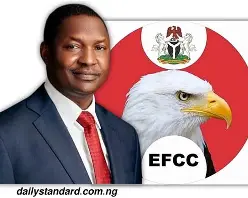
Malami Loses 48 Properties as EFCC Secures Final Forfeiture in Abuja Court
ABUJA, Nigeria — In a landmark victory for Nigeria’s anti-corruption drive, the Economic and Financial Crimes Commission (EFCC) on Wednesday, July 15, 2026, secured the final forfeiture of 48 properties linked to former Attorney-General of the Federation and Minister of Justice, Abubakar Malami, SAN, to the Federal Government.
Delivering judgment, Justice Joyce Abdulmalik of the Federal High Court in Abuja ruled that the EFCC had successfully proven the properties were reasonably suspected to be proceeds of unlawful activities and were not acquired through legitimate sources of income.
The decision marks a significant step in the agency’s long-running efforts to recover assets allegedly tied to corruption during high-level public service.
The forfeiture comes amid heightened public scrutiny of former officials and serves as a strong deterrent message: no one is above the law, regardless of past positions or influence.
While Malami has not been convicted of any criminal offence in this matter, the civil forfeiture process allows the government to reclaim assets suspected to be illicitly obtained without requiring a full criminal conviction.
This victory adds to the EFCC’s growing list of high-profile asset recoveries.
The agency has intensified operations targeting politically exposed persons, with recent successes including forfeitures from various officials and businessmen.
Such actions are critical in a country where grand corruption has long drained public resources needed for infrastructure, healthcare, education, and poverty alleviation.
Abubakar Malami served as Attorney-General under former President Muhammadu Buhari’s administration (2015–2023).
His tenure was often praised by supporters for legal reforms but criticized by opponents over alleged selective justice and opacity in certain high-stakes matters.
The forfeiture case highlights ongoing debates about accountability for public office holders even after leaving power.
For ordinary Nigerians struggling with economic hardship, news of recovered assets offers a glimmer of hope that looted funds might eventually be channeled back into public service.
However, many citizens remain skeptical, demanding not just forfeitures but also prosecutions, transparent management of recovered assets, and systemic reforms to prevent future abuses.
The EFCC’s success in this case demonstrates the power of persistent investigation and judicial processes.
It reinforces the agency’s mandate as Nigeria’s foremost anti-graft body, even as it faces criticism for sometimes appearing slow or selective in high-profile cases.
As more details potentially emerge from related investigations, this forfeiture stands as a reminder of the enduring principle that public service should mean public trust—not personal enrichment.
The Federal Government now takes ownership of the 48 properties, with citizens watching closely to ensure the assets serve the national interest rather than disappearing into another cycle of mismanagement.
 news
news Tinubu Set to Crush Obi, Atiku in 2027 Poll
 news
news Israel Urges Nigerian Doctors for Capacity Training Abroad
 news
news Kano Woman Stabs Boyfriend, Severs Manhood Completely
 world
world Trump Hails Court Win Over New York Times Lawsuit
 news
news Minister Hails NTA’s World-Class Studio in Tinubu Media Push
How do you feel about this news?
Community Additions
Have a news tip, correction, or extra context about this story? Post it below instantly. All submissions appear live on this screen immediately.