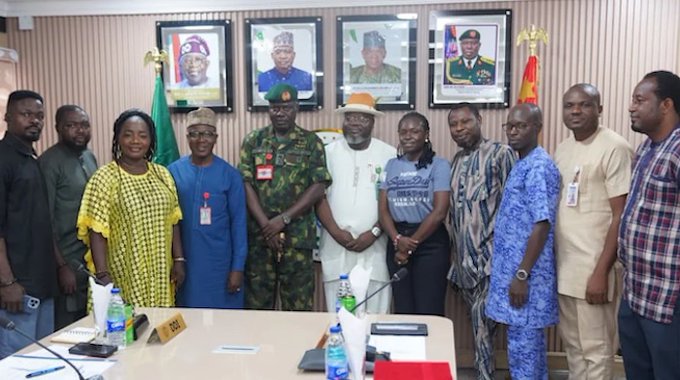
Security Chiefs Team Up with Journalists to Crush Fake News Threats
ABUJA, Nigeria — In a strategic move to counter the growing menace of fake news and disinformation around national security, Nigeria’s top security institutions have deepened collaboration with defence journalists.
The Office of the National Security Adviser (ONSA), Defence Headquarters (DHQ), and the Defence Correspondents Association of Nigeria (DECAN) reaffirmed their commitment to responsible journalism that strengthens public trust and denies adversaries the weapon of falsehood.
The renewed partnership was sealed during separate courtesy visits by DECAN’s leadership, led by President Chief Odita Sunday, to Dr. Chido Onumah, Special Adviser on Strategic Communication and Civil Society Liaison to the National Security Adviser, and Major General Samaila Uba, Director of Defence Information, in Abuja.
Chief Odita described the relationship as a “strategic partnership,” noting that while troops defend the nation on the battlefield, journalists complement these efforts through accurate, balanced, and responsible reporting that informs and educates the public.
He called for improved access to official briefings, specialised training for correspondents, dedicated media facilities, and greater inclusion of defence journalists in key engagements.
DECAN also announced plans to launch its quarterly publication, The Defence Correspondent, in October 2026 to highlight the achievements and activities of the Armed Forces.
Dr. Chido Onumah commended DECAN’s professionalism and pledged to present their requests to National Security Adviser Mallam Nuhu Ribadu.
He emphasised capacity building to enable journalists to report with greater accuracy and responsibility.
Major General Samaila Uba echoed this sentiment, describing defence correspondents as vital partners.
He warned of the dangers posed by misinformation, disinformation, social media manipulation, and artificial intelligence, urging journalists to always verify sensitive information through official military channels before publication.
“Responsible journalism strengthens national security by denying adversaries the opportunity to exploit false narratives designed to create fear, erode public confidence, or damage the reputation of our Armed Forces,” Uba stated.
He also cautioned against publishing classified information that could jeopardize operations or aid terrorists.
The engagements reflect broader national efforts to combat fake news, which has become a significant challenge in Nigeria’s complex security environment.
By fostering trust and open communication between security agencies and the media, stakeholders hope to build a more informed public and a resilient information ecosystem.
This collaboration comes at a critical time when accurate reporting on defence and security issues can influence public perception, support troop morale, and contribute to overall national stability.
As Nigeria continues to grapple with various security challenges, initiatives like this underscore the power of truthful information as a tool for peace and progress.
 news
news Tinubu Set to Crush Obi, Atiku in 2027 Poll
 news
news Israel Urges Nigerian Doctors for Capacity Training Abroad
 news
news Kano Woman Stabs Boyfriend, Severs Manhood Completely
 world
world Trump Hails Court Win Over New York Times Lawsuit
 news
news Minister Hails NTA’s World-Class Studio in Tinubu Media Push
How do you feel about this news?
Community Additions
Have a news tip, correction, or extra context about this story? Post it below instantly. All submissions appear live on this screen immediately.