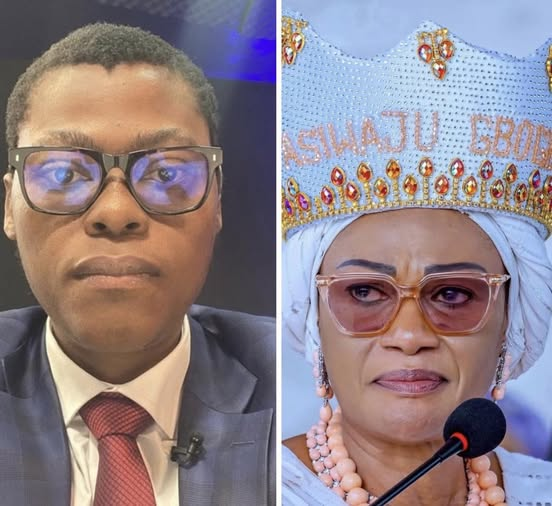
Cut Convoy Before Lecturing Musicians on Charity, Rufai Urged Remi Tinubu
LAGOS, Nigeria — In a sharp public rebuke that has ignited fresh debate on leadership, privilege, and public accountability, prominent broadcaster Rufai Oseni has taken First Lady Senator Oluremi Tinubu to task over her recent call for Nigerian musicians to tone down luxury spending and channel more wealth into charitable causes.
Oseni’s criticism, shared widely on X (formerly Twitter), directly challenges the First Lady’s advice delivered during the launch of the National Community Food Bank in Lokoja, Kogi State.
Mrs. Tinubu had urged top artists including Davido, Burna Boy, and Asake to establish foundations and support vulnerable Nigerians, noting that while luxury cars like Ferraris, Maybachs, and Rolls-Royces are desirable, the government cannot shoulder the social burden alone.
She cited Senegalese-American singer Akon’s philanthropic efforts as a model.
In response, Oseni posted a video purportedly showing the First Lady’s convoy and posed a pointed question: “The president’s wife says musicians should buy less Ferrari and co and spend more for charity. Can govt officials also reduce their convoy?”
The First Lady’s remarks highlighted the struggles of small-scale traders — sellers of pepper, vegetables, okra, melon, and akara—and emphasized the need for private sector and individual philanthropy to complement government efforts. She donated significantly to empower petty traders and stressed respect for humble livelihoods.
Yet Oseni’s retort taps into a broader public sentiment: calls for sacrifice from citizens often ring hollow when political elites appear insulated from similar restraint. Convoys, security details, and ostentatious official lifestyles have long been flashpoints in Nigerian discourse, symbolizing disconnect between leaders and the led.
This is not the first time Rufai Oseni, known for his outspoken commentary on Arise TV, has weighed in on governance and accountability.
His intervention has sparked mixed reactions online—some applauding the consistency check, others defending the First Lady’s right to encourage philanthropy while dismissing the convoy critique as selective outrage.
Nigeria’s music superstars have indeed engaged in substantial giving over the years. Davido, Burna Boy, and others have funded scholarships, hospital bills, disaster relief, and youth empowerment initiatives.
Critics of Oseni argue that individual charity, however generous, cannot replace systemic governance reforms. Supporters counter that public officials must model the moderation they preach.
At its core, the exchange reflects deeper tensions in a country grappling with economic hardship, widespread poverty, and questions of elite responsibility.
As inflation bites and living costs soar, Nigerians increasingly demand that those at the top — whether in government or entertainment — demonstrate tangible solidarity.
The First Lady’s appeal, while well-intentioned, has inadvertently opened a conversation on hypocrisy, leadership by example, and the optics of power.
Whether it leads to meaningful reflection or fades as another social media storm remains to be seen.
In the end, Rufai Oseni’s challenge cuts to the heart of public trust: in a nation where many struggle daily, those with influence — from Aso Rock to the stage — carry a heavier moral burden to walk the talk.
 news
news Tinubu Set to Crush Obi, Atiku in 2027 Poll
 news
news Israel Urges Nigerian Doctors for Capacity Training Abroad
 news
news Kano Woman Stabs Boyfriend, Severs Manhood Completely
 world
world Trump Hails Court Win Over New York Times Lawsuit
 news
news Minister Hails NTA’s World-Class Studio in Tinubu Media Push
How do you feel about this news?
Community Additions
Have a news tip, correction, or extra context about this story? Post it below instantly. All submissions appear live on this screen immediately.