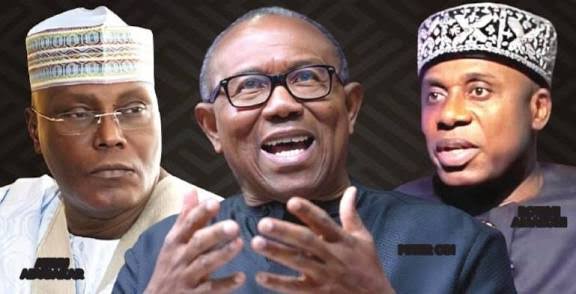
US Lobbyist Urges Peter Obi to Forge Opposition 'A-Team' with Atiku/Amaechi Ahead of 2027 General Elections
Lagos, Nigeria – In a striking intervention from Washington, a prominent U.S. political strategist closely tied to President Donald Trump’s circle has publicly appealed to Peter Obi, the 2027 presidential candidate of the Nigeria Democratic Congress (NDC), to set aside personal and party ambitions and join forces with former Vice President Atiku Abubakar and former Rivers State Governor Rotimi Amaechi.
The goal: to build what he termed an unstoppable “A-Team” capable of defeating incumbent President Bola Ahmed Tinubu in the 2027 general elections.
Dr. Karl Von Batten, Managing Partner of the Washington-based lobbying and strategic advisory firm Von Batten-Montague-York, L.C., made the remarks on Friday amid reports of alleged threats to Obi’s safety under the current administration.
The comments, which blend concern for personal security with blunt political strategy, have ignited fresh speculation about opposition realignments in Africa’s most populous nation.
Nigeria’s political landscape ahead of the January 2027 polls remains highly fragmented.
Peter Obi, who gained massive youth and urban support in 2023 under the Labour Party banner, now flies the NDC flag.
Atiku Abubakar, a perennial contender with deep northern networks, leads the African Democratic Congress (ADC) ticket, with Rotimi Amaechi — a formidable southern politician, ex-governor, and former Transportation Minister — as his running mate.
Earlier efforts at a broad opposition coalition involving Atiku, Obi, Amaechi, and others, including Nasir El-Rufai, have faced hurdles due to party loyalties, personal ambitions, and strategic disagreements.
Rabiu Kwankwaso, the influential Kano politician once seen as a potential Obi ally, has not delivered the expected northern breakthrough for that alignment, according to the narrative driving current discussions.
Von Batten’s intervention carries weight because his firm was retained by Atiku’s camp in a $1.2 million, 12-month contract signed in March 2026 to bolster the former vice president’s international reputation and engage U.S. policymakers.
The firm has a Republican orientation and has been vocal on Nigerian electoral matters, including criticism of the Independent National Electoral Commission (INEC) processes.
Reacting to reports of threats against Obi, Von Batten stated:
“The threats to Mr. Peter Obi’s well-being are shocking. We pray for the safety of Mr. Peter Obi and his supporters.”
He urged Nigerians to transcend ethnic, religious, and regional divides, framing the election as a battle against a common challenge:
“Nigerians of all genders, religions and tribes… have a common enemy, who by all accounts, is prepared to do everything to stay in power.”
The most pointed element was his direct call for unity:
“We hope Mr. Obi will join forces with former Nigerian Vice President Atiku Abubakar and his running mate, Mr. Rotimi Amaechi, to form an A-Team that will unleash an unstoppable movement, to bring true change and prosperity to Nigerians.”
Political analysts note that such an alliance could represent the most formidable challenge to Tinubu’s re-election.
Atiku brings extensive national structures, experience in governance, and northern influence.
Amaechi offers credibility in the South-South, technocratic credentials from his infrastructure work, and cross-regional appeal.
Obi commands enthusiastic youth support, a reputation for frugality and anti-corruption messaging, and strong performance in urban and southeastern areas.
Together, they might consolidate anti-incumbent sentiment fueled by economic hardships, insecurity, and governance critiques.
However, significant obstacles remain: deep-seated personal rivalries, logistical challenges of merging platforms, questions of ticket positioning (presidential vs. vice-presidential slots), and the risk of vote-splitting if unity fails.
This episode highlights the internationalization of Nigerian politics.
Opposition figures have actively courted U.S. support, while the Tinubu administration navigates its own diplomatic relationships.
Von Batten’s firm has previously pushed for U.S. scrutiny of Nigerian electoral processes and alleged irregularities.
As of now, there has been no immediate public response from Obi or his NDC camp to the specific appeal, though discussions of opposition unity have circulated for months.
Supporters of Obi emphasize his independent base and organic grassroots momentum, while Atiku’s allies stress the need for pragmatic alliance-building to avoid repeating 2023’s fragmented outcome.
President Tinubu’s camp has not commented directly on these developments but continues to project confidence based on incumbency advantages, control of state machinery, and ongoing economic reform narratives.
With over a year until the polls, the coming months will test whether Nigeria’s opposition can overcome historical fragmentation.
A successful “A-Team” could reshape the contest into a genuine three-way race or binary choice; failure might hand Tinubu a smoother path.
For ordinary Nigerians grappling with inflation, insecurity, and unemployment, the stakes could not be higher: a contest not just of personalities, but of competing visions for the country’s future.
This story is developing. Veteran observers caution against overinterpreting any single statement, noting that Nigerian politics often features fluid alliances that shift with negotiations, incentives, and ground realities.
 news
news Tinubu Set to Crush Obi, Atiku in 2027 Poll
 news
news Israel Urges Nigerian Doctors for Capacity Training Abroad
 news
news Kano Woman Stabs Boyfriend, Severs Manhood Completely
 world
world Trump Hails Court Win Over New York Times Lawsuit
 news
news Minister Hails NTA’s World-Class Studio in Tinubu Media Push
How do you feel about this news?
Community Additions
Have a news tip, correction, or extra context about this story? Post it below instantly. All submissions appear live on this screen immediately.