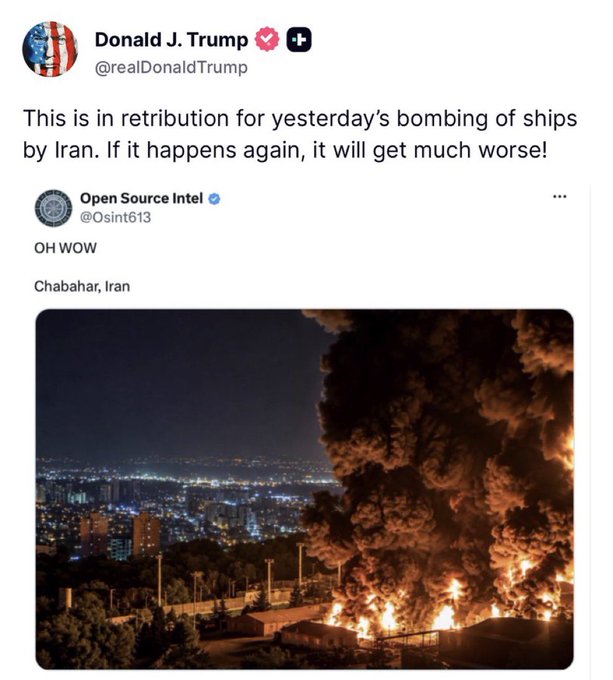
US Launches Fresh Air Strikes on Iran’s Chabahar Port, Bushehr Region
WASHINGTON / TEHRAN— The United States conducted new air strikes on Iranian targets on Wednesday, July 8, 2026, hitting two marine piers and a maritime traffic control tower at Chabahar port, according to Iranian state media. Separate strikes in Bushehr province did not damage the Bushehr nuclear power plant, officials reported.
U.S. Central Command (CENTCOM) confirmed the operations, stating they were launched to “further degrade Iran’s ability to threaten freedom of navigation” in the Strait of Hormuz following Iranian attacks on commercial vessels.
The strikes come as President Donald Trump declared an earlier ceasefire “over” and warned of continued military pressure.
The latest U.S. action follows Iranian assaults on tankers in the vital waterway, which handles roughly 20% of global oil trade.
Iran has repeatedly targeted vessels to assert control over shipping routes, prompting international concern over maritime security and energy prices. Oil markets reacted sharply, with prices surging amid fears of broader disruption.
Iranian officials vowed a strong response, threatening to close the Strait of Hormuz again and potentially withdraw from the Nuclear Non-Proliferation Treaty (NPT).
Explosions were also reported in Bandar Abbas, adding to the sense of escalating confrontation.
The strikes occurred as Trump engaged with NATO leaders in Turkey. He described recent indirect talks with Iran in Doha as “very good” but emphasized that the U.S. retains the option to act unilaterally on Iran’s nuclear program.
The developments have strained relations with Gulf states and complicated ceasefire efforts brokered earlier in the year.
This marks a significant escalation in the ongoing U.S.-Iran tensions, building on months of exchanges involving Israel, proxy militias, and direct military posturing.
Civilian and military casualties remain a critical concern, with both sides accusing the other of endangering regional stability.
For ordinary Iranians and global shipping communities, the conflict brings renewed uncertainty.
Families near targeted areas face disruption, while international shipping firms grapple with rerouting decisions and rising insurance costs.
Analysts warn that prolonged instability could have severe ripple effects on global energy markets and economic recovery efforts worldwide.
As live updates continue to emerge from the region, the international community watches closely. Diplomatic channels, including those involving the UN and regional mediators, are under pressure to prevent further deterioration.
The coming days will test whether military action leads to de-escalation or a dangerous new phase in the conflict.
For now, the message from Washington is clear: freedom of navigation will be defended, even at the cost of direct confrontation. Iran’s response may well determine the trajectory of this volatile chapter in Middle East affairs.
 news
news Tinubu Set to Crush Obi, Atiku in 2027 Poll
 news
news Israel Urges Nigerian Doctors for Capacity Training Abroad
 news
news Kano Woman Stabs Boyfriend, Severs Manhood Completely
 world
world Trump Hails Court Win Over New York Times Lawsuit
 news
news Minister Hails NTA’s World-Class Studio in Tinubu Media Push
How do you feel about this news?
Community Additions
Have a news tip, correction, or extra context about this story? Post it below instantly. All submissions appear live on this screen immediately.