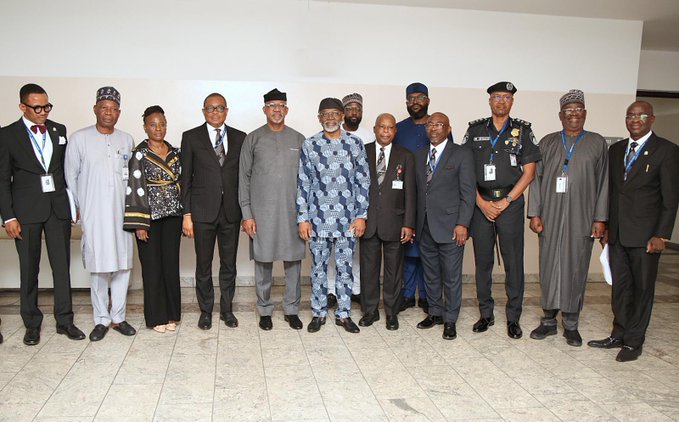
Game-Changer for Security: President Tinubu Inaugurates Presidential Working Group on National Policing Bill
Abuja, Nigeria – July 7, 2026 – In a decisive move hailed as proactive leadership in the face of persistent security threats, President Bola Ahmed Tinubu has inaugurated a high-powered Presidential Working Group tasked with crafting the National Policing Bill.
This landmark step operationalizes the recently passed constitutional amendment enabling state police across Nigeria’s 36 states.
Represented by his Chief of Staff, Mr. Femi Gbajabiamila, who will chair the committee, President Tinubu emphasized the need for swift action.
“The Constitution Amendment Bill establishes the framework for dual policing, but it does not operationalise it. That work is left to the National Policing Bill,” he stated.
A Long-Awaited Reform Gains Momentum
The initiative follows the National Assembly’s passage of the Constitution Alteration (State Police) Bill, 2026, which proposes a dual structure: the Federal Police Service alongside 36 independent State Police Services.
This historic shift addresses decades of calls for decentralized, community-oriented policing better attuned to local realities.
Key elements of the upcoming National Policing Bill will include:
- Minimum national policing standardsState readiness certificationRobust federal-state coordination mechanismsStrong accountability frameworksHuman rights safeguardsFiscal guidelines for sustainable funding
The Working Group, which includes the Attorney-General of the Federation, the President of the Nigerian Bar Association, the Chairman of the Nigeria Governors’ Forum, the National Security Adviser, the Inspector-General of Police, and other key stakeholders, is expected to deliver an implementation-ready draft bill promptly.
Governors, Legal Experts Rally Behind the Vision
Ogun State Governor Dapo Abiodun, speaking on behalf of the Nigeria Governors’ Forum, welcomed the development as a direct response to Nigerians’ long-standing demand for effective, localized security.
He noted that state police would build on the success of regional outfits like Amotekun in the Southwest and could add nearly 200,000 officers if each state recruits around 6,000 personnel.
Attorney-General and Minister of Justice, Lateef Fagbemi, SAN, described the move as timely given Nigeria’s security landscape.
“There is no denying the fact that we are in a critical moment security-wise, and all hands must be on deck,” he said, urging swift ratification by state assemblies.
Nigerian Bar Association President Afam Osigwe reaffirmed the NBA’s support while stressing the importance of safeguards: “We must ensure we do not create a monster. The right legal framework must guarantee accountability and prevent oppression.”
Why This Matters: Potential Benefits for Nigerians
Experts and advocates have long highlighted the advantages of state police, including faster response times to local crimes, deeper knowledge of community terrain and dynamics, improved intelligence gathering, and greater accountability to state residents.
Proponents argue it will complement federal efforts, reduce response lags in a vast country, and empower communities in the fight against banditry, insurgency, and other threats.
President Tinubu’s administration is demonstrating foresight by preparing the operational framework even before the full constitutional process concludes, signaling strong commitment to tangible security improvements.
This development represents a significant milestone in Nigeria’s governance evolution—one that could strengthen national security architecture while respecting federalism.
As the committee begins its work, Nigerians across the country will be watching closely for a policing system that delivers safety, upholds rights, and fosters lasting peace.
 news
news Tinubu Set to Crush Obi, Atiku in 2027 Poll
 news
news Israel Urges Nigerian Doctors for Capacity Training Abroad
 news
news Kano Woman Stabs Boyfriend, Severs Manhood Completely
 world
world Trump Hails Court Win Over New York Times Lawsuit
 news
news Minister Hails NTA’s World-Class Studio in Tinubu Media Push
How do you feel about this news?
Community Additions
Have a news tip, correction, or extra context about this story? Post it below instantly. All submissions appear live on this screen immediately.