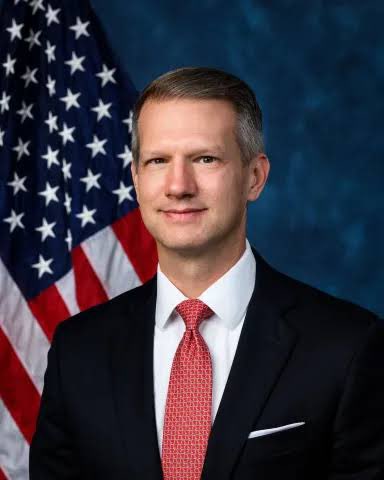
US Congressman Vows Close Monitoring of Nigeria’s 2027 Presidential Election
WASHINGTON/LAGOS — In a statement that has sparked intense debate across Nigeria’s political landscape, United States Congressman Riley Moore has declared that American lawmakers will closely monitor the country’s 2027 general elections.
The remark, made during a public engagement, underscores growing international interest in the conduct and outcome of polls in Africa’s most populous nation.
“We’ll be paying close attention to Nigeria’s 2027 election,” Moore stated, emphasizing that the US would watch not only the results but also the manner in which the electoral process unfolds.
The comment has gone viral on Nigerian social media, with mixed reactions ranging from cautious optimism to outright suspicion of foreign interference.
Rep. Riley Moore, a Republican from West Virginia, has been vocal on Nigerian affairs, particularly issues related to the persecution of Christians, terrorism, and religious freedom.
He has previously sponsored resolutions condemning violence against Christians in Nigeria and advocated for designating the country as a Country of Particular Concern (CPC).
His engagement stems from congressional investigations and bipartisan concerns about insecurity, governance, and human rights.
Moore’s latest comments come against the backdrop of Nigeria’s complex political environment. With President Bola Tinubu’s administration navigating economic reforms, security challenges, and preparations for the next electoral cycle, the US signal adds another layer of international scrutiny to domestic processes.
The statement has elicited strong responses within Nigeria. Supporters of opposition figures, including those aligned with Peter Obi and the NDC, view it as potential support for demands for credible polls.
Others, including ruling APC sympathizers, caution against perceived external meddling in sovereign affairs, arguing that Nigerians alone should determine their leadership.
Critics on social media point to past US involvement in African elections and question motives, while some citizens express hope that heightened attention could deter electoral malpractices such as vote-buying, violence, and manipulation.
Many Nigerians, however, emphasize that true change must come from within through citizen vigilance, judicial independence, and institutional reforms.
The United States has historically engaged with Nigeria on democratic governance, anti-corruption, and counter-terrorism.
Congressional interest often intensifies around election periods, with calls for transparent processes, respect for human rights, and free media.
Moore’s remarks align with his prior advocacy linking security assistance to improvements in protecting vulnerable populations, especially Christians facing targeted violence in parts of the country.
As Nigeria approaches 2027, key issues likely to draw international observation include the independence of the Independent National Electoral Commission (INEC), voter registration integrity, campaign financing, and the management of security during polls.
Past elections, including the disputed 2023 cycle, have left lingering questions about technology, result transmission, and judicial adjudication of disputes.
While external attention can spotlight irregularities, veteran observers stress that sustainable democracy in Nigeria ultimately depends on internal mechanisms: strong institutions, an active civil society, a professional security apparatus, and an informed electorate.
The viral attention on Moore’s statement highlights deep public anxiety over the integrity of future polls and the desire for outcomes that genuinely reflect the will of over 200 million citizens.
Whether Congressman Moore’s pledge translates into concrete diplomatic or observational efforts remains to be seen.
For now, it serves as a timely reminder — as Nigeria gears up for another critical electoral test — that the eyes of the world are increasingly fixed on how Africa’s giant conducts its democratic affairs.
The coming months will test not only Nigeria’s electoral institutions but also its ability to manage both domestic aspirations and international expectations.
 news
news Tinubu Set to Crush Obi, Atiku in 2027 Poll
 news
news Israel Urges Nigerian Doctors for Capacity Training Abroad
 news
news Kano Woman Stabs Boyfriend, Severs Manhood Completely
 world
world Trump Hails Court Win Over New York Times Lawsuit
 news
news Minister Hails NTA’s World-Class Studio in Tinubu Media Push
How do you feel about this news?
Community Additions
Have a news tip, correction, or extra context about this story? Post it below instantly. All submissions appear live on this screen immediately.