Pain to Power: ADC Ekiti Launches Post-Election Ad-Hoc Committees
ADO-EKITI, 2 July 2026—Just days after a bruising defeat in the June 20, 2026, Ekiti State governorship election, the African Democratic Congress (ADC) in Ekiti has signaled a resolute determination not to fade into political irrelevance.
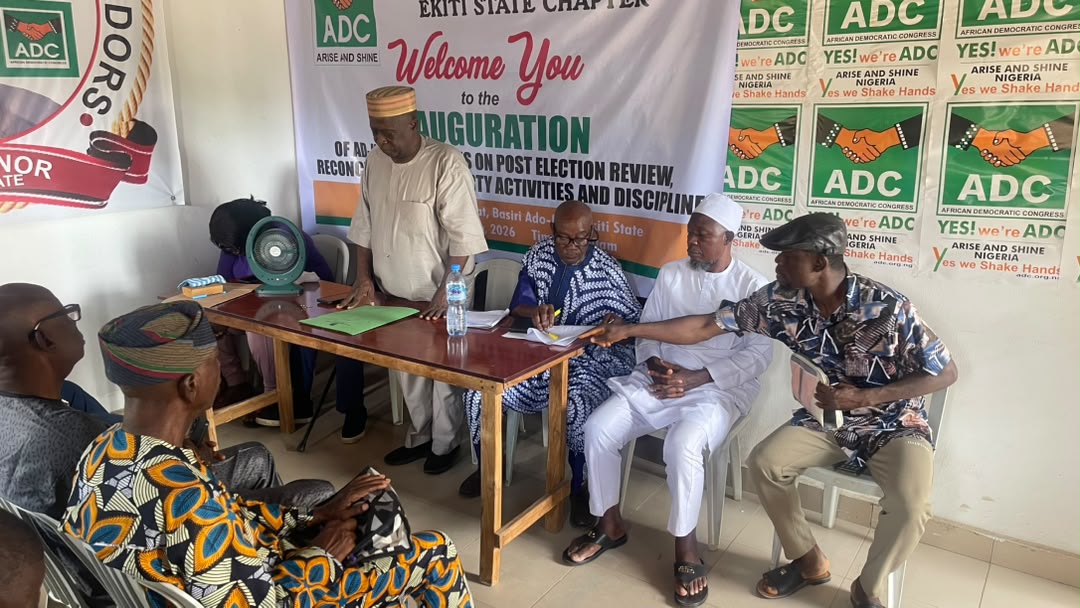
On Thursday, July 2, 2026, at the party’s State Secretariat in Basiri, Ado-Ekiti, State Chairman Dr. Bamidele Ekunola inaugurated three ad-hoc committees tasked with dissecting the party’s performance, reconciling aggrieved members, and rooting out internal sabotage.
In a candid, forward-looking speech delivered to party leaders, stakeholders, committee members, and journalists, Dr. Ekunola acknowledged the disappointment of the election outcome while projecting confidence in the party’s future.
“While we did not achieve the result we worked and prayed for, the ADC remains standing, stronger in resolve, and more determined to build a party that Ekiti people can trust,” he declared.
The June 20 poll saw incumbent Governor Biodun Oyebanji of the All Progressives Congress (APC) secure a commanding re-election with 319,224 votes, dominating all 16 local government areas and claiming nearly 85% of valid votes cast.
The Peoples Democratic Party (PDP) candidate, Oluwole Oluyede, placed second with 40,543 votes, while ADC’s standard-bearer, Ambassador Dare Bejide, came a distant third with 12,872 votes.
Bejide had rejected the results, describing the exercise as a “bad day for democracy” marred by alleged irregularities, voter intimidation, and vote-buying.
The low vote haul for ADC, despite pre-election optimism and campaigns emphasizing fresh alternatives, underscored deep structural and organizational challenges that the new committees are now mandated to confront.
Dr. Ekunola announced the formation of three focused ad-hoc committees following wide consultations within the State Working Committee (SWC):
- Post-Governorship Election Review Committee– Chaired with a mandate for an “honest, data-driven review” of the party’s structures across all 16 Local Government Areas and 177 Wards.
Members must identify successes, failures, and underlying causes, producing actionable recommendations to reposition ADC for victory in 2027 and future contests. Findings are to be factual rather than personal.
-
Reconciliation Committee– Tasked with addressing “bruises” left by the election. The committee is to reach out to aggrieved candidates, leaders, and members, listen to grievances, and facilitate healing. “No party grows when its house is divided,” Ekunola emphasized, urging the group to restore a unified voice for ADC in Ekiti.
-
Anti-Party Activities and Disciplinary Committee – This body will investigate credible reports of sabotage, insubordination, and actions that undermined the party, its candidates, or its interests. Culprits face disciplinary measures in line with Article 21 of the ADC Constitution.
The chairman stressed: “Loyalty must have consequences, and so must betrayal.”
However, he warned against witch-hunts, cover-ups, or external influences like money, friendship, or fear.
The committees have ambitious deadlines: 21 days for an interim report on anti-party activities and 30 days for comprehensive reports on the review and reconciliation efforts. The SWC pledged full logistical and material support.
Dr. Ekunola called on all ADC members in Ekiti to cooperate fully, providing information and time to the committees.
“The goal is not to destroy, but to rebuild,” he said. He framed the initiative philosophically: “A party that refuses to look in the mirror cannot grow. Today, we are choosing truth over denial, unity over division, and discipline over impunity.”
Dr. Bamidele Ekunola’s emergence as State Chairman earlier in 2026 came amid internal party dynamics and efforts to strengthen ADC’s presence in Ekiti.
The party had entered the 2026 race with visible campaigns and high expectations, positioning itself as a viable third force in a state long dominated by APC and PDP structures.
The post-election introspection comes at a critical juncture, as Nigeria’s political landscape gears up for the 2027 general elections.
Political observers note that such internal mechanisms—combining self-assessment, healing, and accountability—are common in resilient parties seeking revival after setbacks.
Success will hinge on the committees’ objectivity, the party’s willingness to implement recommendations, and its ability to translate analysis into grassroots improvements in organization, messaging, and voter mobilization.
As the committees begin their work, Ekiti’s political arena watches closely. For ADC, this is more than routine housekeeping; it is a deliberate pivot from electoral pain toward renewed relevance in one of Nigeria’s most politically conscious states.
Dr. Ekunola concluded the inauguration with a prayer: “May God guide you, and may ADC Ekiti rise again.”
The coming weeks will reveal whether this bold self-examination marks the beginning of a genuine resurgence for the African Democratic Congress in Ekiti.
 news
news Tinubu Set to Crush Obi, Atiku in 2027 Poll
 news
news Israel Urges Nigerian Doctors for Capacity Training Abroad
 news
news Kano Woman Stabs Boyfriend, Severs Manhood Completely
 world
world Trump Hails Court Win Over New York Times Lawsuit
 news
news Minister Hails NTA’s World-Class Studio in Tinubu Media Push
How do you feel about this news?
Community Additions
Have a news tip, correction, or extra context about this story? Post it below instantly. All submissions appear live on this screen immediately.